
What Happens During an EMDR Therapy Session?

If you’ve been told EMDR might help with trauma or anxiety, you may be picturing something mysterious — hand-waving, hypnosis, or being forced to relive your worst memories in vivid detail. Maybe a friend mentioned it changed their life but couldn’t quite explain what actually happened in the room. That uncertainty stops a lot of people from starting.
The reality is far more structured, collaborative, and gentle than most people expect. In fact, EMDR is recommended by the American Psychological Association as an effective treatment for post-traumatic stress disorder. Knowing what an EMDR session actually involves can take much of the fear out of that first appointment. Here’s a step-by-step look at what to expect, from your very first session to how you might feel walking out the door.
What Is EMDR Therapy?
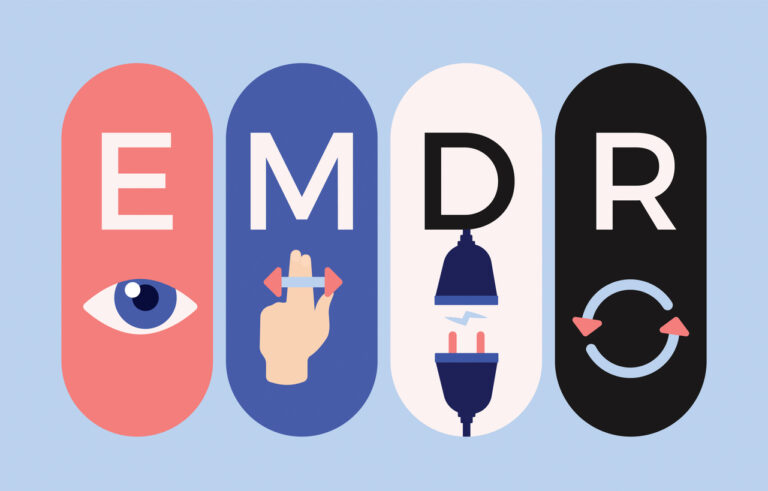
EMDR stands for Eye Movement Desensitization and Reprocessing. It’s a structured therapy that helps your brain reprocess distressing memories so they lose their emotional intensity. Instead of talking through a painful memory again and again, you work through it while doing a gentle back-and-forth eye movement or other rhythmic stimulation. You can learn more on our EMDR therapy page.
The idea is that trauma can get “stuck” in the nervous system, replaying with the same sharp intensity years after the event. EMDR helps those memories finally settle, so they feel like something that happened in the past — rather than something still happening now.
Who EMDR Helps
EMDR was originally developed for trauma and PTSD, and that’s still where it’s best known. But its use has expanded well beyond that over the years. People often come to EMDR for:
- Trauma and PTSD — whether from a single event, like an accident, assault, or loss, or from ongoing experiences over time
- Anxiety — including panic, health anxiety, and worry that won’t quiet down
- Phobias — such as fear of driving, flying, or medical procedures
- Grief, painful memories, and low self-worth rooted in past experiences
If a specific memory or pattern keeps hijacking your present — showing up as a racing heart, a flood of emotion, or an automatic reaction you can’t control — EMDR is often a strong fit.
How to Prepare for Your First Session
The good news: you don’t need to prepare much at all. You won’t be asked to give a detailed play-by-play of your trauma on day one, and a good therapist will never push you faster than you’re ready to go.
It helps to come in with a general sense of what you’d like to work on, even if it’s vague — “I freeze up during conflict” or “I can’t stop thinking about what happened.” You don’t need the perfect words for it.
Practically speaking, wear comfortable clothing and try to give yourself a little quiet time afterward rather than rushing into a demanding meeting. Beyond that, your therapist will guide every step, so you can walk in without any pressure to have it all figured out.
The 8 Phases of EMDR — and What Each One Feels Like
EMDR follows an eight-phase protocol. These aren’t eight separate appointments — some phases move quickly, and several often happen within a single session. Understanding them ahead of time helps the process feel far less unknown.
Phase 1: History-taking. Your therapist learns your background and works with you to identify the memories or triggers to focus on. This feels like a normal, conversational intake — just talking.
Phase 2: Preparation. You learn what to expect and practice calming techniques, like a “safe place” visualization, so you have tools to steady yourself whenever you need them. Nothing distressing happens here. This phase is about building trust and making sure you feel safe before any deeper work begins.
Phase 3: Assessment. Together, you and your therapist choose a specific memory to work on. You’ll also identify the negative belief attached to it — something like “I’m not safe” or “It was my fault” — along with the positive belief you’d rather hold instead, such as “I’m safe now” or “I did the best I could.”
Phase 4: Desensitization. This is the reprocessing phase most people picture when they think of EMDR. You briefly bring the memory to mind while following your therapist’s bilateral stimulation, pausing frequently to notice whatever comes up. More on exactly how this works below.
Phase 5: Installation. As the memory loses its emotional charge, you strengthen the positive belief so it genuinely starts to feel true, not just something you’re telling yourself.
Phase 6: Body scan. You check in on where you might still be holding tension, since trauma often lingers physically — in a tight chest, a clenched jaw, or a knot in the stomach.
Phase 7: Closure. Every session ends with you feeling grounded and calm, whether or not that particular memory is fully processed. You never leave in the middle of distress.
Phase 8: Reevaluation. At the start of your next session, you and your therapist check in on your progress and decide together where to go next.
What a Typical Session Actually Looks Like
Once you’re past the early preparation phases, a reprocessing session settles into a comfortable rhythm. You’ll sit in a chair, and your therapist will guide you to hold a memory briefly in mind while adding bilateral stimulation — which is a technical-sounding term for a very simple thing.
Bilateral stimulation just means a left-right, back-and-forth pattern. Most often, it’s your eyes following your therapist’s fingers or a light bar moving side to side. It can also be gentle taps on your knees or hands, or alternating tones played through headphones. Whatever the format, you stay fully awake, aware, and in control the entire time. This is not hypnosis, and you can pause or stop whenever you want.
Sessions typically run 60 to 90 minutes — a bit longer than standard talk therapy — so there’s room to open up a memory and bring you back to a calm, grounded place before you leave. You work in short sets: a bit of stimulation, then a pause where your therapist asks what you noticed. Thoughts, images, body sensations, or emotions might surface, and you simply report them without forcing or judging anything. Sometimes a memory shifts in surprising ways, connecting to things you hadn’t thought about in years.
How you may feel during and after. During processing, emotions can rise and then ease — and that easing is exactly the point. Afterward, some people feel noticeably lighter and relieved. Others feel tired or a little raw, much like you might after a hard physical workout. Processing can also continue between sessions, showing up as new insights or vivid dreams. All of this is normal, and your therapist will send you home with grounding tools to use if anything feels intense.
How Many Sessions Will I Need?
There’s no single answer, because it truly depends on what you’re working through. A single, recent event might resolve in a handful of sessions. Longstanding or repeated trauma usually takes longer, since there are more memories and patterns to reprocess.
That said, many people begin noticing shifts within the first several reprocessing sessions — a memory that once brought tears might start to feel more neutral. Your therapist will set a realistic pace with you and adjust as you go. EMDR isn’t meant to drag on indefinitely, and because progress is checked at every step, you’ll always have a sense of where things stand.
Is EMDR Right for You?
EMDR tends to be a good fit if you have specific memories or triggers driving your distress, if talk therapy alone hasn’t quite moved the needle, or if putting everything into words feels overwhelming. Because you don’t have to narrate every painful detail out loud, many people find it far more approachable than they expected. If anxiety is your main concern, you may also want to read our related post on the benefits of EMDR therapy for anxiety.
For those who want to dig into the research, the EMDR International Association and the American Psychological Association’s guidance on EMDR for PTSD are trustworthy starting points, and this peer-reviewed overview of how EMDR works walks through the eight phases in clinical detail.
It isn’t the only path forward, and it isn’t right for everyone or every moment in life. The best way to find out is a consultation, where a therapist can assess whether EMDR, another approach, or a combination of methods makes the most sense for you.
Getting Started at IPG
Starting trauma therapy takes real courage, and you don’t have to figure out the first step on your own. At the Institute for Personal Growth, our EMDR-trained therapists will walk you through the entire process at a pace that feels safe, answering your questions at every turn.
Whether you’re near our Jersey City, Highland Park, or Freehold office or prefer online sessions from anywhere in New Jersey, our therapists can help. To get started, call 800-379-9220, visit our contact, or use the Zocdoc “Book Online” button.
You can also learn more about our trauma and PTSD treatment and anxiety therapy services to see how we can support you.
Clinically reviewed by Susan Menahem, LCSW — last updated July 2026.