
Anxious Attachment in Dating: Signs and Healthier Responses
Clinically reviewed by Susan Menahem, LCSW — last updated August 2026.
You’ve reread the same text three times, trying to decide if “haha yeah” means something’s wrong. You’ve drafted a message, deleted it, and drafted it again. You’ve felt a wave of relief so big it’s almost dizzying the moment someone finally writes back.
If dating tends to bring out this kind of vigilance in you, you may be noticing what psychologists call an anxious attachment style. It’s a common pattern, not a character flaw — and understanding it is often the first step toward feeling steadier in relationships.
What Is Anxious Attachment?
Attachment theory describes the patterns we develop, usually starting in early childhood, for connecting with the people we depend on. When a caregiver’s responsiveness was inconsistent — warm and available one moment, distracted or unpredictable the next — a child can learn that closeness isn’t guaranteed and has to be monitored and maintained. That learned vigilance doesn’t disappear with age. It often resurfaces in adult romantic relationships, where the stakes of connection feel similarly high.
People with an anxious attachment style tend to crave closeness and reassurance, and they can become preoccupied with a partner’s availability. This isn’t about being “needy” — it’s a nervous system that has learned to treat uncertainty in a relationship as a signal of danger. The American Psychological Association has explored how these early attachment bonds shape adult relationships in more depth, if you’d like additional background (APA: Attachment Bonds).
Signs of Anxious Attachment in Dating
Anxious attachment can look different from person to person, but some patterns show up often:
- Fear of abandonment. A partner being ten minutes late or slower than usual to text back can trigger a spike of worry that something is fundamentally wrong.
- Overthinking texts and conversations. Analyzing word choice, punctuation, or response time for hidden meaning.
- Constant reassurance-seeking. Repeatedly asking a partner if they’re okay, if the relationship is okay, or if you did something wrong.
- Protest behaviors. Withdrawing, testing a partner, or picking a fight in an unconscious attempt to provoke reassurance or closeness.
- Losing yourself in the relationship. Reshaping your schedule, opinions, or interests around a partner’s, sometimes without fully noticing it’s happening.
None of these signs on their own means someone has an anxious attachment style — but when they form a consistent pattern across relationships, it’s worth paying attention to. If anxiety is a near-constant companion in your dating life, it may be worth exploring further with an anxiety specialist.
Where Anxious Attachment Comes From
Anxious attachment often traces back to early relationships where care felt inconsistent rather than absent. It can also develop later, shaped by a relationship where a partner was genuinely unpredictable, dismissive, or hot-and-cold. Anxious attachment is frequently discussed alongside its counterpart, avoidant attachment, since the two styles can create a reinforcing cycle: the more one partner pursues, the more the other withdraws, which increases the first partner’s anxiety.
Recognizing where the pattern came from isn’t about assigning blame — to yourself, caregivers, or past partners. It’s about understanding that the pattern was learned, which also means it can be unlearned.
What Anxious-Avoidant Pairing Looks Like
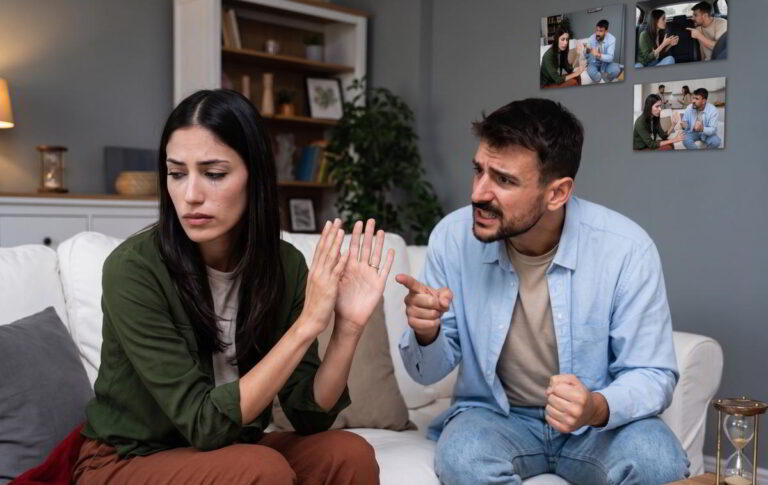
One of the most common — and most painful — dynamics in dating is the anxious-avoidant pairing. An anxious partner’s push for closeness can feel, to an avoidant partner, like pressure or engulfment, prompting them to create distance. That distance then confirms the anxious partner’s fear of abandonment, prompting more pursuit. Both people can end up feeling misunderstood, even though each is simply responding from their own attachment wiring.
Naming this cycle can be relieving. It reframes the conflict as a pattern between two nervous systems rather than a referendum on either person’s worth or commitment.
Healthier Ways to Respond When Anxiety Shows Up
- Pause before reacting. When the urge to send a fourth follow-up text arrives, try waiting fifteen minutes. Often the intensity settles enough to respond from a calmer place.
- Name the feeling internally. Simply noting “this is my anxious attachment activating” can create enough distance to choose a response rather than react automatically.
- Communicate needs directly. Instead of testing a partner or withdrawing, try stating plainly what would help: “I feel more secure when we check in before a few days go by.”
- Build a life outside the relationship. Friendships, hobbies, and personal goals reduce the pressure on a romantic partner to be a sole source of stability.
- Practice self-soothing skills. Grounding techniques, journaling, or reminding yourself of times a relationship survived a rough patch can help regulate the nervous system in the moment.
Building Secure Attachment Over Time
Attachment styles aren’t fixed for life. Many people move toward “earned secure attachment” through consistent, safe relationships and through therapeutic work that helps them understand and rewire old patterns. This shift usually isn’t linear — old fears can resurface during stress — but the goal isn’t perfection. It’s building enough self-awareness and internal steadiness that anxiety doesn’t have to drive the relationship. Individual therapy is often where this work happens, and for those already partnered, couples counseling can help both people understand and respond to each other’s attachment patterns together.
When to Consider Therapy
If anxious attachment patterns are affecting your ability to date, sustain relationships, or feel at ease in your own company, therapy can help. A therapist can help identify where the pattern originated, build tools for managing anxiety in real time, and work toward a more secure relational style — whether or not you’re currently dating someone.
IPG’s therapists see clients at three New Jersey locations — Freehold, Highland Park, and Jersey City — and offer telehealth statewide, making it easier to find support that fits your schedule and comfort level.
Support at IPG
Learning that your attachment patterns are learned responses — not flaws — can be a genuine relief. You don’t have to untangle them on your own, and you don’t have to stay stuck in patterns that no longer serve you.
IPG offers individual and couples therapy at our three New Jersey offices — Jersey City, Highland Park, and Freehold — plus secure telehealth for clients anywhere in NJ. To get started, call 866-602-4521, visit our contact page, or use the Zocdoc “Book Online” button.

Podcast: Play in new window | Download